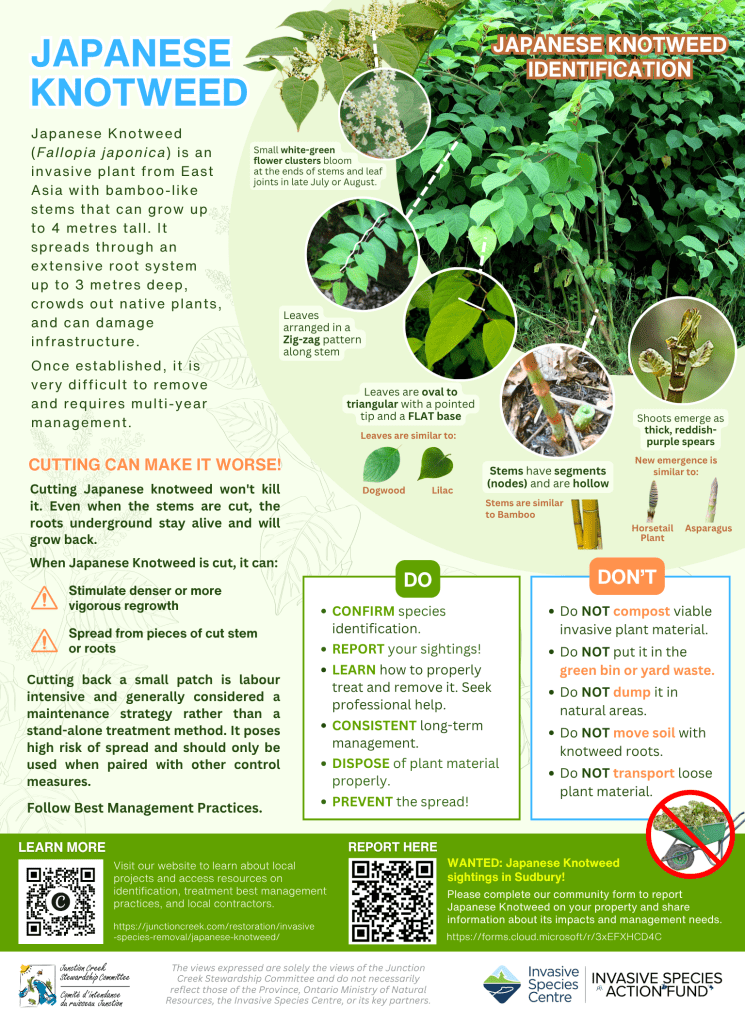
Japanese Knotweed (Fallopia japonica) is a high-risk invasive plant that poses growing ecological, social, and economic challenges in Greater Sudbury. Native to East Asia, it has distinctive bamboo-like stems and can grow up to 4 metres tall. Beneath the surface, its extensive root system can reach depths of up to 3 metres, allowing it to spread rapidly and making it extremely difficult to eradicate.
Japanese Knotweed thrives in a wide variety of habitats, including wetlands, riparian areas, roadsides, ditches, and fence lines. It forms dense stands that aggressively outcompete native vegetation, reduce biodiversity, and degrade sensitive ecosystems. In urban and developed areas, it can also damage infrastructure and create costly management challenges.
Once established, Japanese Knotweed is highly persistent and typically requires coordinated, multi-year management to control and prevent further spread.
Reporting Japanese Knotweed infestations is essential for tracking its distribution and spread throughout Greater Sudbury. These reports help identify priority areas for monitoring and management, supporting more effective control efforts and protecting local ecosystems. Sightings of invasive species can be reported through EDDMapS.org or iNaturalist.ca, both of which offer free mobile apps for smart devices.
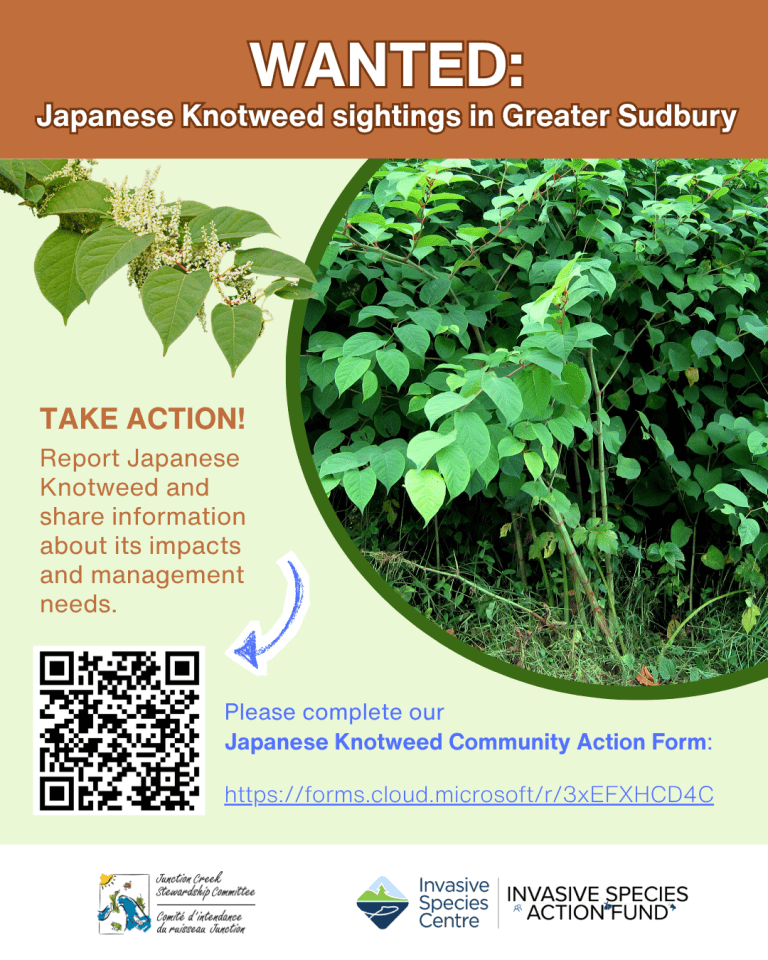
Help Us Track Japanese Knotweed in Greater Sudbury
If you’re dealing with Japanese Knotweed on your property, we want to hear from you! Your experience can help us better understand where Japanese Knotweed is found, the challenges it creates for residents, and where management support may be needed.
Through our Japanese Knotweed Community Action Form, you can report a sighting, share how Japanese Knotweed is affecting your property, and tell us about any management efforts or challenges you’ve experienced. Click here to fill out the form.
Every report helps us build a better understanding of Japanese Knotweed across Greater Sudbury and supports future invasive species planning and local management efforts.


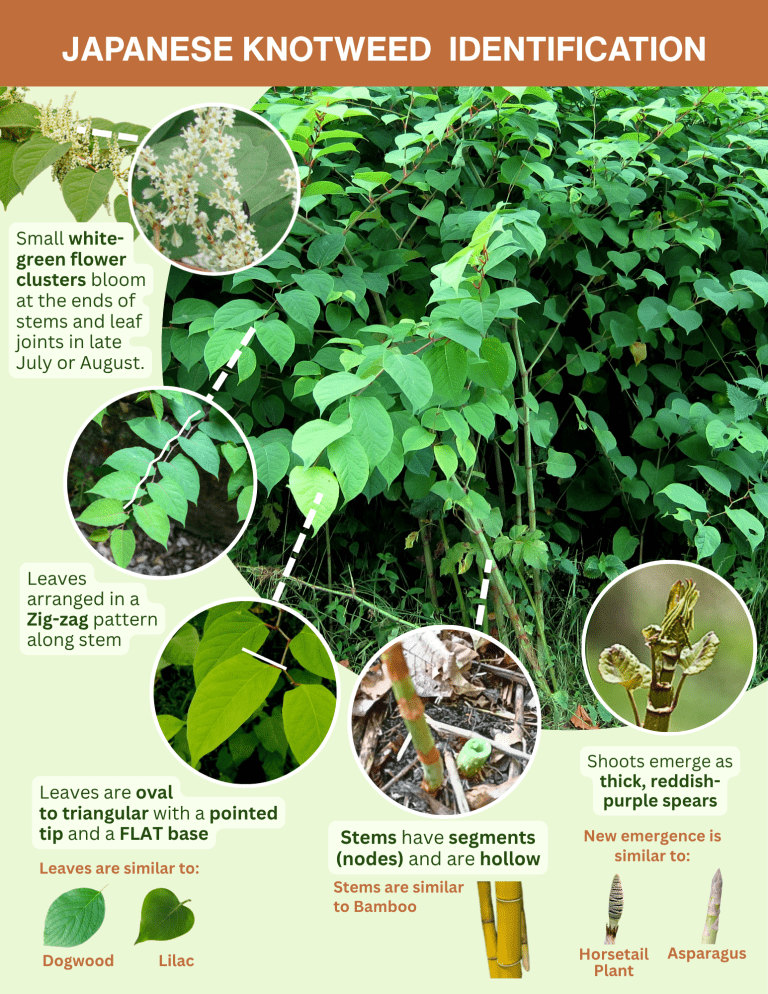
Japanese Knotweed is one of the most aggressive invasive plant species in Ontario, capable of rapidly spreading and displacing native vegetation, damaging infrastructure, and reducing biodiversity. Once established, it is difficult and costly to control, making early detection and responsible management essential. By following Best Management Practices, landowners, contractors, and community members can help prevent the accidental spread of knotweed while supporting long-term restoration efforts. Whether you are identifying a new infestation, planning treatment, or disposing of plant material, taking the right approach protects our local ecosystems and improves the success of management efforts.
Selecting the right management approach depends on the size, location, and extent of the infestation. No matter which method is used, preventing the spread of Japanese Knotweed throughout treatment, handling, transport, and disposal is essential to successful management.
Use our Decision Guide Tool to help you properly treat and dispose of Japanese Knotweed. Download the PDF to click the links!
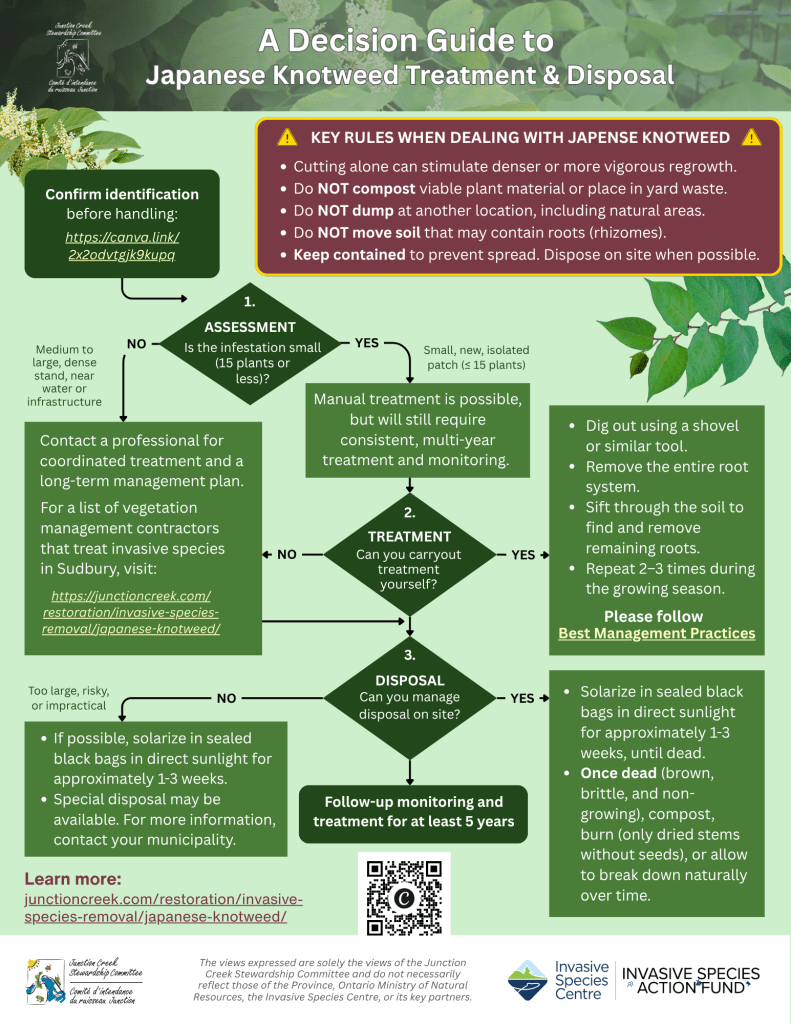
Small, newly established patches may be managed by homeowners using recommended control methods, provided care is taken to prevent the spread of plant fragments and a consistent long-term management plan can be maintained. Where feasible, plant material should be treated on-site and no longer viable before disposal. If off-site disposal is required, securely contain the material and contact 311 for guidance on municipal disposal options.
Large, well-established infestations are much more difficult to control. Attempting to remove them without the proper equipment or expertise can unintentionally spread the plant and stimulate regrowth. For these situations, consider hiring a qualified contractor with experience managing invasive plants or licensed herbicide applicators.
A list of experienced and certified invasive plant management contractors serving the Greater Sudbury area:
Invasive Veg Solutions
705-207-8187
invasivevegsolutions@gmail.com
IMPORTANT: Cutting Alone Does Not Eradicate Knotweed
Cutting Japanese Knotweed can help manage growth, but it does not kill the plant. The underground root system (rhizomes) remains active and can produce new shoots.
If knotweed is cut without proper handling, it may:
- Regrow more vigorously
- Spread through stem or root fragments
- Expand into new areas if material is moved or left on bare soil
For this reason, cutting should always be followed by proper on-site treatment and careful containment of all plant material.
The Junction Creek Stewardship Committee has been managing a patch of invasive Japanese Knotweed near Clinton Ave. & Perreault St. to repair the greenspace and help native plants flourish! This site is also acting as a public demo site for Japanese Knotweed treatment.
We are using a chemical-free “cutting and tarping” or “smothering” method which is a more environmentally friendly alternative to herbicides. First the plant is cut and removed, then a weighted tarp covers the site to block sunlight and water while also heating up the roots. This creates unfavorable conditions and stops the plant from growing back. After several years of “smothering” and maintenance, the site will be ready to be replanted with native plants.
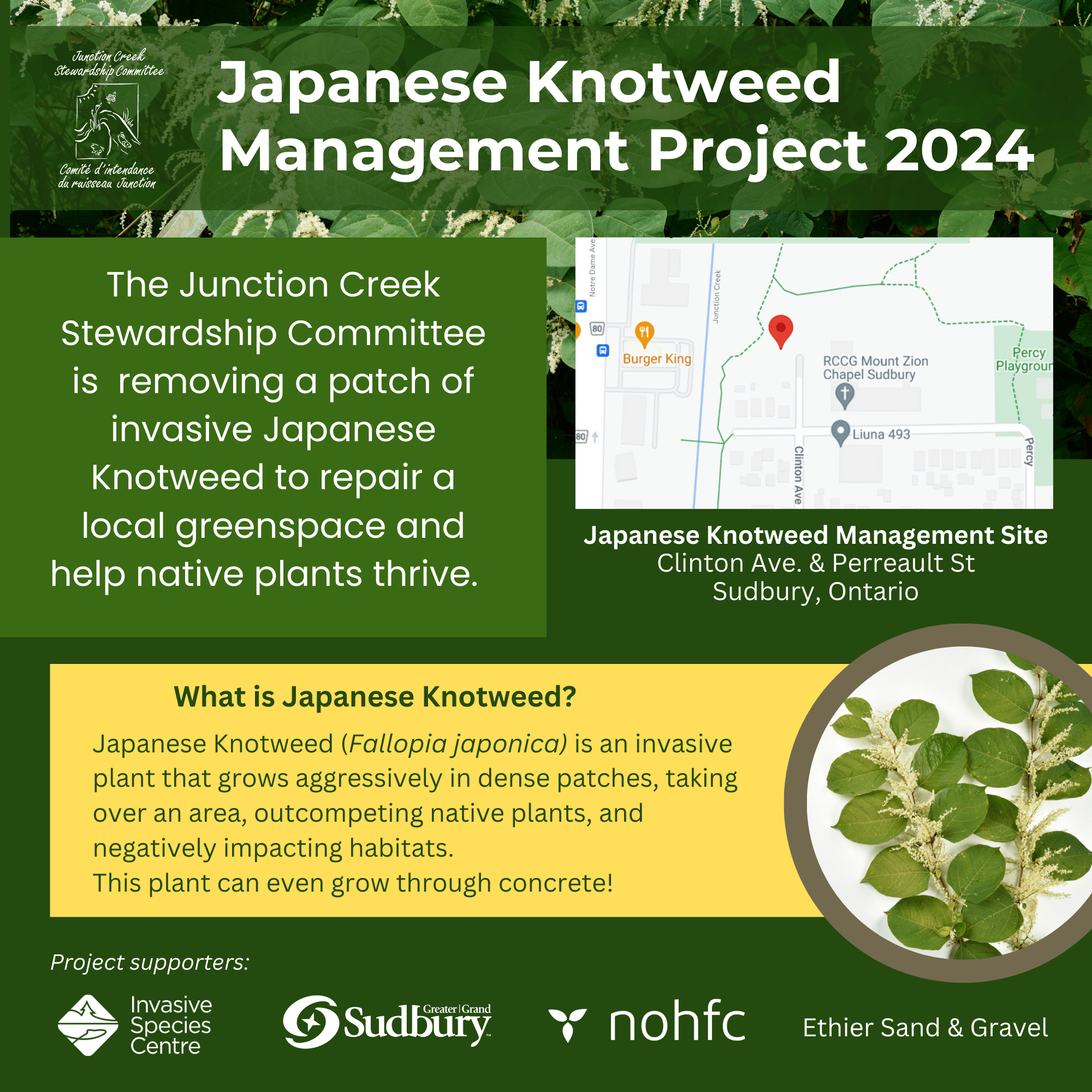
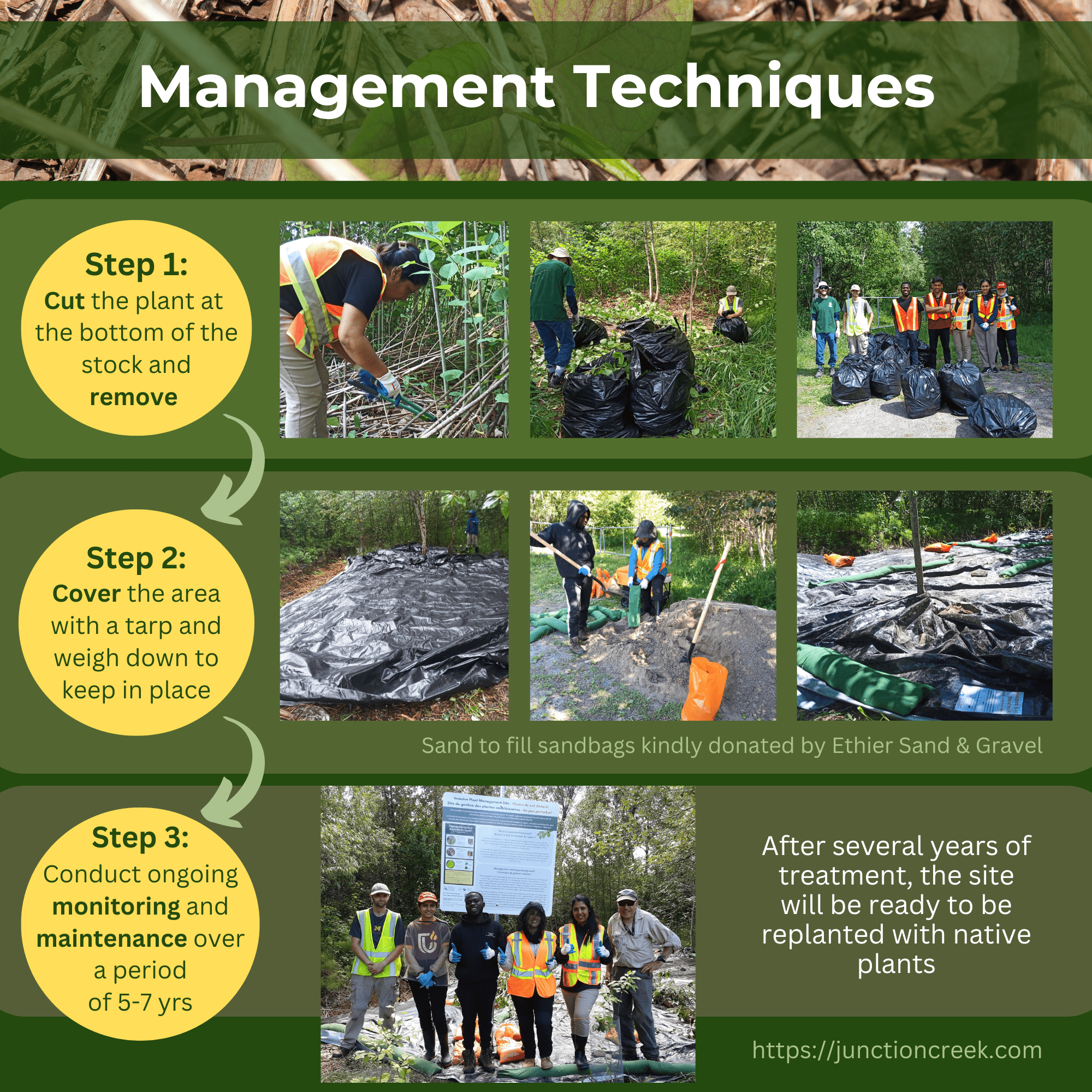
Management Timeline:
- 2023 – Developed a site-specific five-year Japanese Knotweed Management Plan.
- 2024 – Began implementing management and control efforts.
- 2025 to Present – Continuing long-term monitoring, treatment, and adaptive management to reduce infestations and prevent further spread.
The project was made possible with support from the Invasive Species Centre’s Invasive Species Action Fund and the Ontario Ministry of Natural Resources and Forestry, Northern Ontario Heritage Foundation, and the City of Greater Sudbury. Also, a special thank you to Ethier Sand & Gravel Ltd for donating sand to fill the sandbags!
The Junction Creek Stewardship Committee is launching a new initiative in 2026, A Community Approach to Managing Japanese Knotweed in Greater Sudbury. The project aims to strengthen Greater Sudbury's capacity to monitor and manage Japanese Knotweed through community-led action while laying the foundation for coordinated, long-term management across the municipality.
Japanese Knotweed is a high-risk invasive species in Greater Sudbury that poses growing ecological, social, and economic challenges. It spreads aggressively, is difficult to manage without specialized knowledge, and can impact natural ecosystems, private property, and infrastructure. As awareness and reporting of this species increase, so too does the need for expanded support, coordinated efforts, and accessible management tools to effectively address its spread.
This project responds to that need through a community-led, evidence-based approach to monitoring, prevention, and management. It aims to strengthen Greater Sudbury’s capacity to understand and respond to Japanese Knotweed while building the foundation for long-term, strategic action.
Key objectives include improving mapping and understanding of infestations, increasing public awareness and reporting, implementing targeted prevention and control measures, and strengthening regional collaboration for ongoing management.
Through field surveys, community science, public education, and on-the-ground interventions, the project will generate reliable data, reduce the spread of Japanese Knotweed, and support residents and partners in taking informed, coordinated action.
This project is funded by the Invasive Species Centre and supporting funder, the Ministry of Natural Resources.
